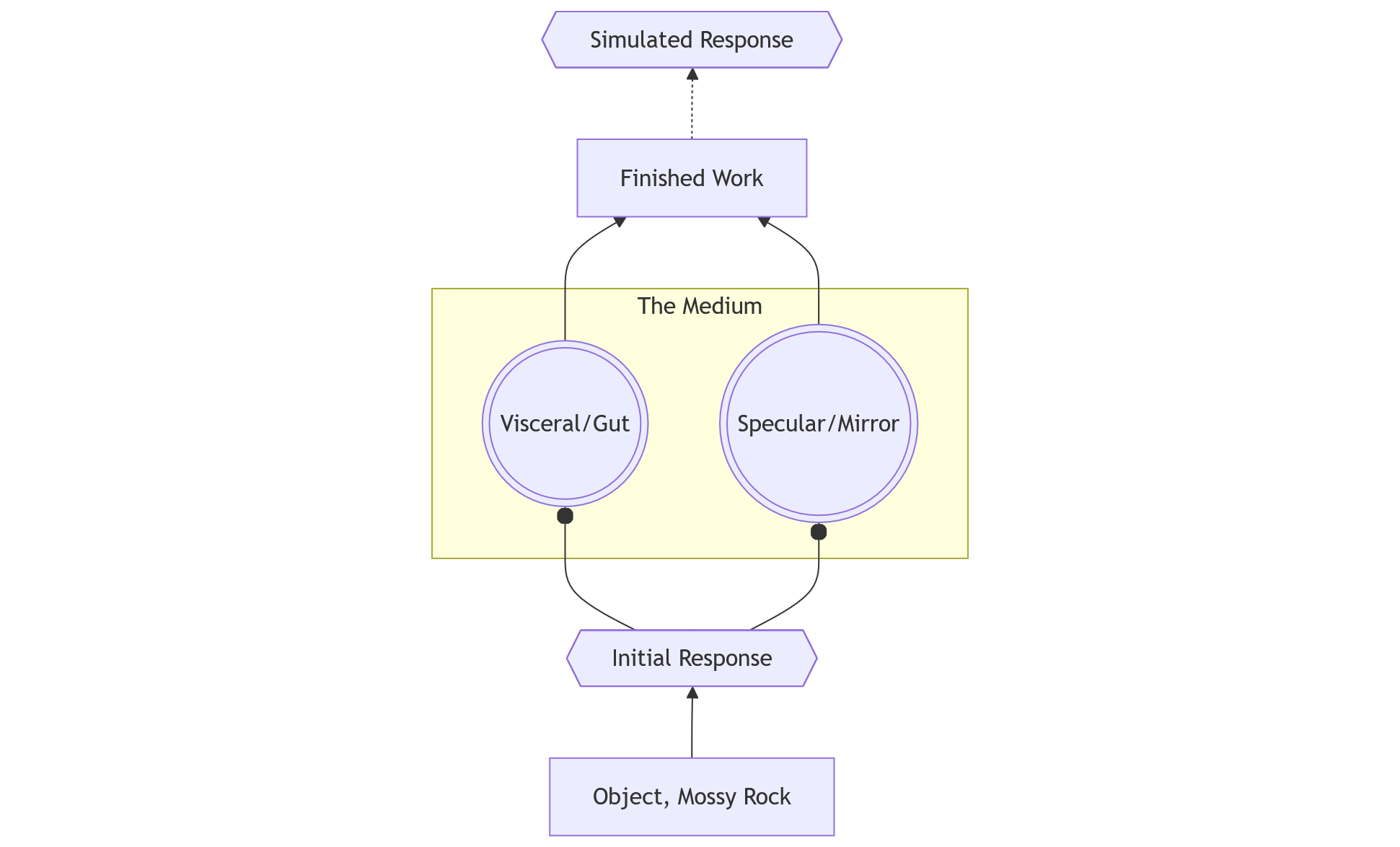
You are on a walk with your family, exploring a local park, feeling largely uninspired for your next project, when you see a rock. The mossy rock, one of several around you, should not interest, let alone inspire, you, but for some reason it does. Maybe it is the way the light hits one half of the rock, creating a bold shadow across its stippled surface. Maybe the way the rock leans against the tree, with a mini crater of soil as proof for its dislodging, builds a curiosity in you. Maybe it is the brown layer on the back of the moss where someone peeled it, a surprising contrast to the yellow-green everywhere else. You are captivated, and when you go home, you decide to represent that response, whatever it was, through your medium. You experiment and tweak and frown and revisit, and, at the end of an embarrassingly long process, you create something which you can engage with, and on engagement experience a powerful one, like the one that inspired you. Congratulations, you have just created art.1
This description could have applied to a painter copying a rock from memory or direct observation; a poet describing the rock and its details, or even a musician composing a lyric-less song. The process could have applied to any artform, and in fact, I posit that the existence of this progression is what defines the process of ‘art’.
The Mossy Rock
In the above example, the object of interest to the artist was a rock, which is about as stable and tangible as can be. However, this does not have to be the only way of engaging with the artistic process. In describing the poetry movement ‘Confessionalism,’ Lucy Collins writes2 that “The expression of personal pain has been regarded as a hallmark of confessional poetry,” citing “destructive family relationships; traumatic childhoods; broken marriages; recurring mental breakdowns; alcoholism or drug abuse” as examples from the key writers of the movement. It would be difficult to claim that writing with “undisguised exposure”3 about these experiences is outside the scope of artistic expression, and my claim is that the object of an art process need not be tangible.4
There is, however, a clear rub between the intangibility of objects and the intangibility of a response to them. My claim is that while objects can be a whole host of things, from physical objects or places to ideas or events, the response exists only emotionally and intellectually (that is, internally).
The Medium Space
What is the medium that an artist creates with? Maybe paint, or a typewriter? For my purposes, I refer to those as tools, and reserve the word ‘medium’ for a specific category within art forms. Consider songwriting, where the linguistic, the visual, and the sonic all collaborate to convey meaning (incidentally, poetry also works with these three categories). You could break these down further into elements (the sentence, the line, colour, shape, pitch, rhythm and so on), but taken together they form a backbone for creation and interpretation. I don’t concern myself too much with defining exactly what media fit into each artform, because there is a good deal of overlap and the grey areas are not too interesting. Instead, I focus on how elements function within a work, how they tend to play within their medium, how they influence elements from other media, and so on. Another point is that art forms are specific traditions and shapes of the much more general act of artistic expression. Thus, when thinking of a general, loose set of categories, I use the terms ‘medium space,’ ‘domain’ or sometimes simply ‘media’.
There are two extremes when working with any given medium space:
- To treat media as a means to an end, preferably quite “invisible,” functioning merely to reach an end response, and
- To treat media as material worthy of being observed and consciously felt.5
The former I call “engaging with the Specular,” and the latter “engaging with the Visceral.” We take some time now to explore these two modes of thinking.
The Specular
A Specular-focused approach places the audience in the exact position of the artist, faithfully reflecting the objects that inspired them, that is, treating the medium as a specular surface. When looking in a mirror, the goal is not to see the mirror at all; it is to see what the mirror reflects. In a similar sense, the Specular is concerned with making the media as invisible as possible.
A friend of mine encountered this media invisibility quite directly through Timothy Schmalz’ sculpture ‘Homeless Jesus,’ portraying a homeless person asleep on a bench. He, like several people who saw the sculpture, was initially fooled into seeing a real person asleep there, and so any feelings of compassion or deep emotion were directed toward reality, not a representation of it; the media of the statue were largely unseen. In a work like this, aesthetics and form are clearly not the only goal. Instead the work can act as “a social statement, meant to bring awareness to Jesus’ literal connection to homeless people…”6. It accomplishes this by directly representing the artist’s object of inspiration, that is, an actual sleeping homeless person.
Examples from poetry would be the Imagism and Confessional movements, Haiku, Found Poetry, and even the inclusion of Epigraphs. We find strong examples in the storytelling artform through memoir and biography.
The Visceral
If an artist “looks” at their object in a Visceral work, they do so only from a peripheral angle. Visceral approaches are all about making the medium tangible and drawing attention to all its elements. This is often accomplished by refusing to represent anything directly at all. An example would be a clouded mirror, which forces you to remember the materials of glass and dust and steam that you would otherwise never register. As a result of this indirect focus, visceral work is often quite difficult to analyse: it may engage its audience powerfully on an intuitive level, but it is quite difficult to figure out why.
Examples from storytelling could include literary fiction (with its strong focus on the media within the art form such as language and character), science fiction, or fantasy. Poetry that taps into this include the work of Gertrude Stein (particularly ‘Tender Buttons’), the Language Poets, and Conceptualism (see Caroline Bergvall’s ‘Drift’)
On Music
At first, music may appear to be necessarily visceral; its sonic elements are often emotional and textural. However, music is still specular on some7 level; the interaction of its elements can represent emotions in quite honest, up-front ways, allowing listeners to immediately know what feelings are shown to them. In such work, tension and release obey their “rules”, tonal harmony functions as expected, and so on. Thus, when you listen to Clair de Lune, even if you don’t guess straight away that it is inspired by “moonlight,” and never guess, solely from observing the work, that it was inspired by a poem of the same name8 (and certainly never guess the words of that poem), you nonetheless easily conclude that whatever objects inspired it must be quite peaceful, maybe melancholic. The picture it evokes is so clear and transparent that the musical medium does successfully disappear a little—your imagination goes places and you might even wind up on the idea of moonlight completely on your own. There is no denying that a photograph, painting, or poem could get you to the idea of “moonlight and its connotations” much more directly, but the specular nature of the piece is still clear, from the fact that Debussy draws from and directly reflects the qualities of his objects through his medium, as mentioned by Jessica Duchen:
“The work shares the poem’s delicacy, its plangent yet subtle suggestions of mingled sorrow and beauty, and the ‘blue note’ in the middle section – which seems almost to evoke those weeping fountains – encapsulates a certain atmosphere that permeates the entire piece.”9
A more visceral piece may be found in minimal music, for example with Steve Reich’s Music for 18 Musicians. Here, the medium is completely impossible to ignore, with its insistent repetition and structure, slowly evolving but always pulsing and pounding. A work like this is hard to place; it is quite dissonant to the audience. Taking this even further, Okkyung Lee’s Ghil fits into the genre of “noise music”—with virtually no clear object to focus on, all we can see is the medium; all we can focus on is the physical clouded mirror. Some may find a work like this needlessly chaotic, and others may suggest it taps into something no other music can. I don’t argue for one or the other, but crucially, whatever is happening here is different to what the more specular pieces do.
On Language
In both visceral and specular works, the ultimate goal of the artist could be one of two things: to have the audience form their unique response, or to guide them toward the original response of the author. A specular artist could represent a rock as directly as possible in the hopes that their audience will come to the same deep feelings that they experienced, but just as easily, their reason for representing the rock itself may be to allow the audience to form their own reactions and responses. Similarly, a visceral artist could work deeply with their media to represent the abstract essence of the rock as experienced on first inspiration, but equally easily, they could work with their media to let the work open up, allowing the audience to react however they do.
In this sense, both approaches draw on identical evaluative questions, and are therefore inextricably linked. The connection deepens with the fact that it is virtually impossible to write a fully specular or fully visceral piece. To be fully specular would require the medium space to be fully invisible, a concept that the ‘Language Poets’ would disagree with. Lyn Hejinian, for example, argues for various features of language as a medium in its own right, in ‘A Rejection of Closure’:
“Language itself is never in a state of rest. Its syntax can be as complex as thought. And the experience of using it […] is inevitably active—both intellectually and emotionally.”10
and later,
“…the incapacity of language to match the world permits us to distinguish our ideas and ourselves from the world and things in it from each other. […] While failing in the attempt to match the world, we discover structure, distinction, the integrity and separateness of things.”11
Similarly, when close-reading Gertrude Stein’s infamous ‘A Carafe that is a Blind Glass,’12 Lyn Hejinian relies on the anatomy13 of Stein’s sentences, referencing The Principles of Psychology, where William James argues for the significance of even the most noble linguistic features:
“There is not a conjunction or a preposition, and hardly an adverbial phrase, syntactic form, or inflection of voice, in human speech, that does not express some shading or other of relation which we at some moment actually feel to exist between the larger objects of our thought. […] We ought to say a feeling of and, a feeling of if, a feeling of but, and a feeling of by, quite as readily as we say a feeling of blue or a feeling of cold.”14
Showing that every element of a sentence matters, not solely because of what it represents about the piece’s object, but because of the inherent characters within every word (and, by extension the character within clauses, lines, paragraphs, etc).
To be fully visceral, on the other hand, requires the removal of all direct communicative power, to not “claim” anything. This might appear quite easy, particularly if you argue that my earlier proposition of music as necessarily representational is a little wishy-washy. In fact, this sort of critique is an established point of debate:
“Some philosophers seem convinced that art is essentially representation […]. Other philosophers, apparently struggling for a compromise, argue that while literature and visual art are representative arts, music is not—a claim that, unhappily, begs a question: if there are “representative arts” and “non-representative” arts, what common feature do they have that authorises us to call them both “art”? Representation being ruled out, we need to find a replacement essential feature.15
However, a perspective on art by Susanne Langer16 actually seems to bolster our model, arguing that art is all about expressing feeling through symbol. In this way, the initial feeling or set of ideas that a stimuli or ‘object’ sparks is not really what art aims to represent, but rather to symbolise them through the medium. For example, a major chord might symbolise happiness, where the word “happiness” in a typical communicative setting would simply point to the concept of happiness, as a sign, rather than a symbol. A fully visceral approach therefore requires symbolism to be quite hidden, largely living within media, and not tangible objects from the natural world. Finally, As Dr. Ellie Anderson explains in reference to music, “We might say that the feeling is in the work; it’s not referring back to the creator, or even back to you, the listener.”17
Applying all this crudely to language, we see that the elements of language could be interpreted as words and symbols, acting as signs to concepts, or, more powerfully, we can consider the elements of language as including higher-level structures like sentences and the gaps between them, allowing for language to “invite” people into concepts symbolically through structure, even without the direct use of metaphor.18 In other words, “language (all language) is a medium for experiencing experience.”19
I believe this emphasis on symbols rather than signal (or, “a system to pointing”20) is what Terrance Hayes was getting at, when seeking out an language “unburdened by people’s expectations”:
“I think music is the primary model—how close can you get this language to be like music and communicate feeling at the base level in the same way a composition with no words communicates meaning? It might be impossible.”21
What next?
Now that I have laid out a sketch of my model, we can begin to test it on a more macro level. For example, how should an artist approach the daunting task of creation and drafting? How do they know when they have a completed work? How do they evaluate their own work? I explore ideas like these in the next chapter.
Notes and References
During the early stages, I preferred something like “Congratulations, you have just arted” here, but to avoid overusing jargon, I reverted to the normal use of the word. If you pay attention to my obstinate phrasing, you might find the spirit of ‘art as action’ implicit throughout my arguments. ↩︎
Lucy Collins, Confessionalism (Blackwell Publishing Ltd., 2001) in “A Companion to 20th Century Poetry,” p.197. ↩︎
Steven Axelrod, Robert Lowell: Life and Art. (Princeton University Press, 1979). ↩︎
In fact, it very rarely is. Lyn Hejinian’s notion of the “event” really nails this idea home. (see “A Fable for Now: Kate Fagan Interviews Lyn Hejinian” here). ↩︎
At the time of writing this, I am heavily exploring the latter, so I can only apologise for any bias in phrasing—I wholeheartedly believe in the necessity and value of both approaches. ↩︎
Lennie Bennett, Emotionally charged ‘Homeless Jesus’ sculpture in Tampa a social statement (Tampa Bay Times, 2016, March 31), accessed here. ↩︎
This sort of strangeness occurs regardless of how you model/represent the artistic process. We must account for music, language, and the visual in one theory, so there are bound to be points that feel a little awkward. This model works generally quite decently across all three and other domains, but if we are after a perfect fit for any individual domain, we will almost certainly tamper with our fit for another in the process. In the future I transition from a one-size-fits-all to a model which fits poetics snugly. You could probably do this with any other medium space. ↩︎
Paul Verlaine, “Clair de Lune,” in One Hundred and One Poems by Paul Verlaine (University of Chicago Press, 2008. ↩︎
Jessica Duchen, Debussy’s “Clair De Lune”: The Story Behind the Masterpiece’ (UDiscover Music, 2019), accessed here. ↩︎
Lyn Hejinian, “The Rejection of Closure,” in The Language of Inquiry (University of California Press, 2000), p.50. ↩︎
Ibid., p. 56. ↩︎
Gertrude Stein, Tender Buttons: The Corrected Centennial Edition (City Lights Books, 2014). ↩︎
Lyn Hejinian, “Two Stein Talks,” in The Language of Inquiry (University of California Press, 2000), p.100. ↩︎
William James, The Principles of Psychology I (Harvard University Press, 1981) p. 238. ↩︎
Derek Allan, Art is never a representation of reality. (Iai.tv, 2026, February 10), accessed here. ↩︎
Susanne Langer, Feeling and Form (Charles Scribner’s Sons, 1953) p.40. ↩︎
Ellie Anderson, “Susanne Langer on Symbolism and Artistic Expression” in Aesthetics and Philosophy of Art Series (2023), accessed here. ↩︎
This is one reason why Lyn Hejinian’s ‘My Life’ is able to work so well—it works with complex webs of association, all centred around the gaps between sentences. ↩︎
Lyn Hejinian, “Reason,” in The Language of Inquiry (University of California Press, 2000), p.344. ↩︎
Gertrude Stein, Tender Buttons: The Corrected Centennial Edition (City Lights Books, 2014). ↩︎
Unknown Writer(s), (2021, February 3). Terrance Hayes. Poetry Foundation, accessed here. ↩︎